Importing a car from Germany without driving it.
Found it on mobile.de, AutoScout24 or at auction? A verified carrier collects it from the seller and delivers it to you loaded on a flatbed or car transporter, running or not.
- Verified carriers
- Running or not
- New alert if the carrier cancels
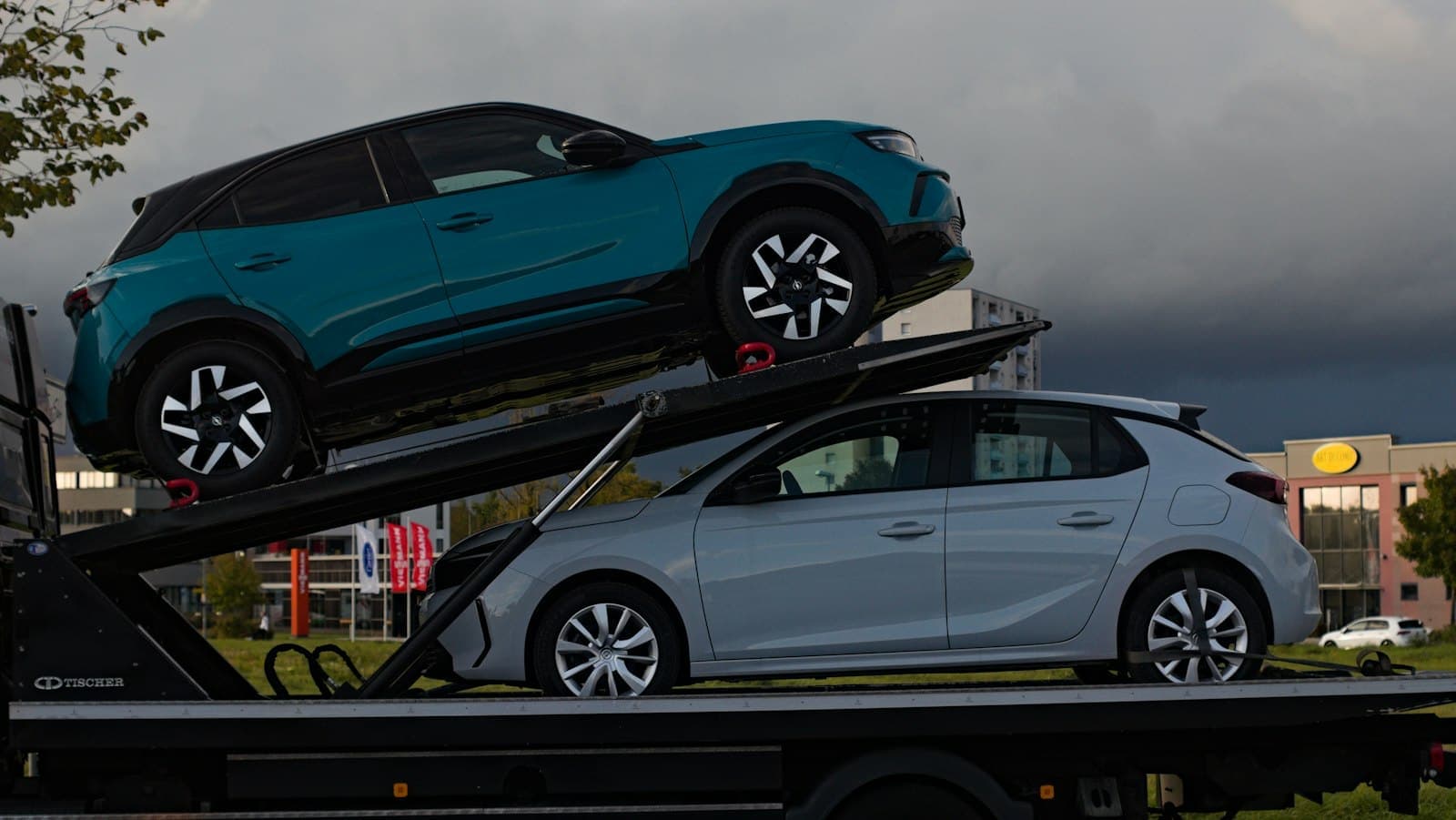
Flatbed, vehicle delivery driver or yourself?
To bring back a car bought in Germany, you can have it transported loaded, entrust it to a vehicle delivery driver or drive it yourself. Only loaded transport suits a car that doesn’t run, and it arrives without a single extra kilometre.
On a flatbed or car transporter
- Non-running car
- Yes, on a flatbed
- Kilometres on the clock
- None
- Plates for the road
- It isn’t driven
A flatbed takes one car, sometimes two. A car transporter carries several and fills up along the way: you may have to wait for a departure.
With a vehicle delivery driver
- Non-running car
- No
- Kilometres on the clock
- The whole distance
- Plates for the road
- Export plates, with insurance
A professional driver drives it to your door: it must run, with plates and insurance valid all the way to France.
Driving it yourself
- Non-running car
- No
- Kilometres on the clock
- The whole distance
- Plates for the road
- Export plates, with insurance
German temporary plates are in principle only valid in Germany: you need export plates and insurance taken out separately. Plus your outward journey.
Collected from the seller, delivered to you.
You choose the German town from the list, just like a French municipality. Your request goes to verified carriers who pass through Germany and near you: on an empty return leg, the price can drop.
- Let the seller know. The carrier comes to the address you give: agree on the day and on handing over the keys.
- It doesn’t run? Say so. Choose “It doesn’t run” and the handling needed: only carriers who accept it are alerted.
- The condition is recorded. Photos at collection from the seller, then at delivery to you.
The paperwork, from Germany to the French carte grise.
Get these documents from the seller, then apply for the French carte grise (registration certificate) within a month.
From the seller
- The original German registration certificate (Zulassungsbescheinigung).
- The invoice or the certificate of sale (certificat de cession).
- The European certificate of conformity (certificat de conformité, COC). Failing that: a certificate from the DREAL (French regional authority) or an individual vehicle approval (réception à titre isolé).
- The latest German roadworthiness test: it is accepted if it is less than 6 months old on the day of your application (car over 4 years old).
In France
- The quitus fiscal (tax clearance certificate): by email to the tax office (service des impôts) for your home address (form 1993-PART-D-SD), or on the ANTS website in some departments.
- The carte grise (registration certificate): on the ANTS website or through an authorised professional, within a month, with proof of address.
- No customs duty. No VAT in France for a used car more than 6 months old and with more than 6,000 km. The malus écologique (environmental penalty) may apply, reduced according to the car’s age.
Checked on 22 October 2026. Sources: Registering a used vehicle (in French), Obtaining a quitus fiscal (in French), Buying a vehicle in Europe (in French), Cost of the carte grise (in French), Temporary plates (City of Munich, in German), Transfer plates (ADAC, in German).

Your questions
How much does it cost to transport a car from Germany to France?
The price depends on the distance, the carrier’s detour, the car’s condition (running or not), access and the date. Each carrier makes their own quote: we don’t display prices.
Quotes are free and with no obligation. A carrier returning empty from Germany can offer a better price.
Which plates do you need to bring a car back from Germany?
To drive it to France, you need German export plates (Ausfuhrkennzeichen), valid for one year at most and never longer than the insurance, which you take out separately.
Temporary plates (Kurzzeitkennzeichen) are only valid until the fifth day after they are issued and, in principle, only in Germany.
On a flatbed or a car transporter, the car isn’t driven. According to the ADAC, the German automobile club, it then does not need to be registered for the journey.
Do you have to pay customs duty or VAT in France?
No customs duty: the car comes from a European Union country.
No VAT in France for a used car, meaning more than 6 months old and with more than 6,000 km. Below either of these two thresholds, it is considered new: VAT is due in France.
How long does it take to bring a car over from Germany?
Each carrier proposes a date on their quote, and you choose. The more flexible your dates (“I’m flexible”), the more journeys may be suitable.
Remember the carte grise (registration certificate): you have one month to apply for it.
Do you transport abroad?
Yes, between France and these countries: Andorra, Austria, Belgium, Czechia, Germany, Italy, Luxembourg, Monaco, Netherlands, Poland, Portugal, Romania, Spain, Switzerland and United Kingdom. The departure or arrival must be in France, except for transport within the United Kingdom (from London to Manchester, for example), whose quotes are in pounds sterling; the foreign city is chosen from the list provided, in the same way as a French town.
In any other case where both the departure and the arrival are outside France, your request is passed on to our team, who will get back to you. For another country, email us at contact@plateau-libre.com.
What if the carrier cancels?
Your request goes straight back out to matching carriers, and the other quotes that are still valid can be booked again.
You then book one of those quotes, or a new one, from your tracking page.
A car to transport within France? Flatbed transport